Trust comes first
A financial product asks for something few other products do: a stranger’s money. Before anyone reads the terms, they decide whether the company looks safe. That decision is made by the brand.
It is made by three audiences. Investors read every pitch against the category leader’s brand. Enterprise clients and partners decide whether a company is safe to trust before the first call is booked. And customers judge an app by its icon, its card and its first screen.
So a fintech brand identity has two jobs at once. It has to carry the credibility of a financial institution, and it has to feel like a product people want to use.
Holding trust and energy together
Many fintech brands settle for one side. Some look like banks: stable, and forgettable. Others look like consumer apps: lively, and hard to trust with a salary.
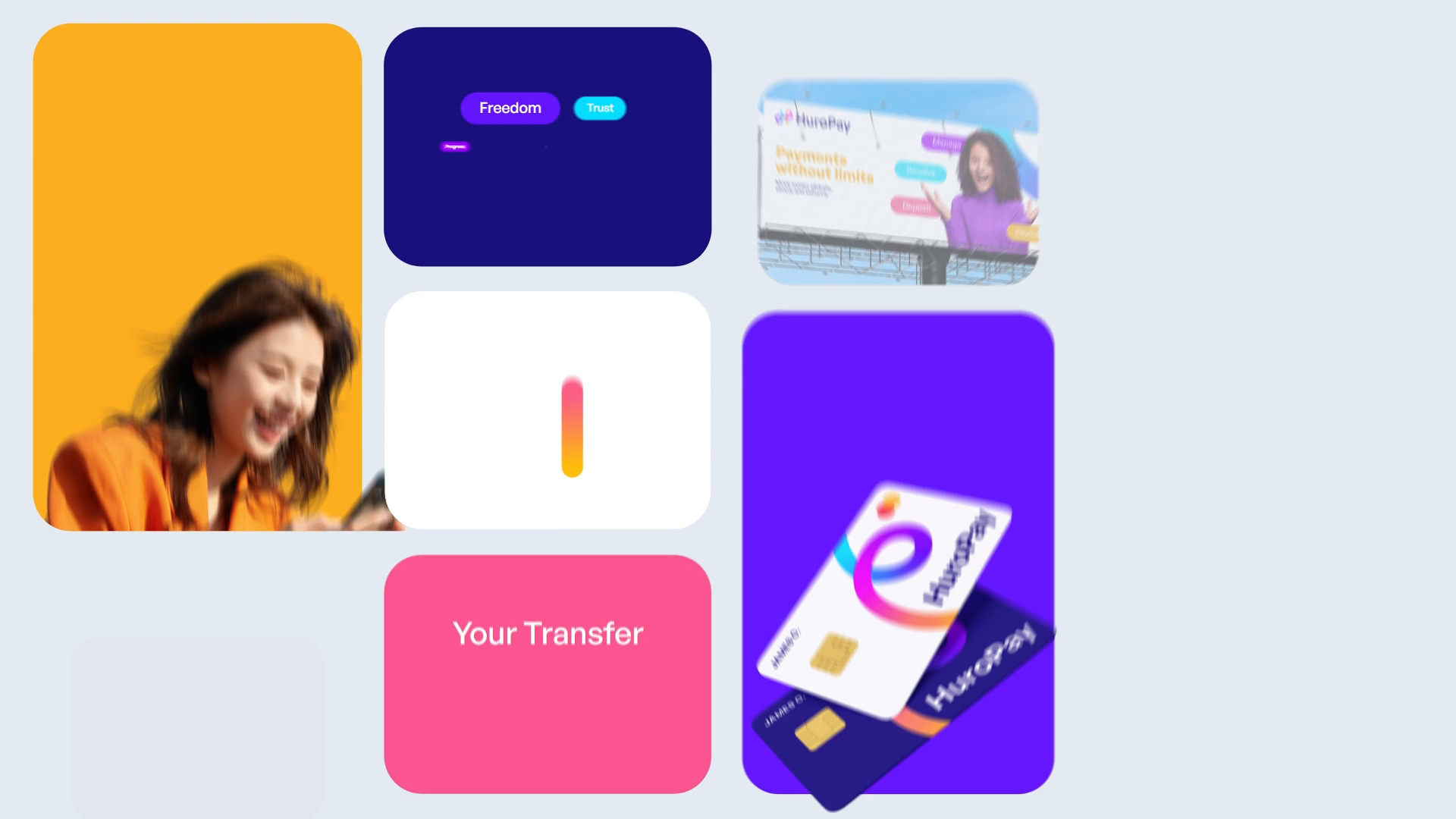
Our work for HuroPay, a digital payments platform, was built to hold both. Its idea is built for movement. A modular, interlocking symbol suggests continuous exchange between people, accounts and payment networks, and rounded geometry keeps it human. Deep indigo and purple establish trust. Cyan, pink and warm orange bring optimism. The identity runs through the banking app, the payment cards, the campaigns and the print.
Investment and growth brands
INVEXA Capital is a different kind of financial brand: a technology growth platform that pairs capital with hands-on operational expertise. Its identity had to move past traditional investment branding and treat capital as a starting point.
The idea is unlocked growth. The INVEXA X traces the path from investment to acceleration to exit, with forward-facing arrows for momentum. Steel blues, slate and near-black balance institutional credibility with a modern technology character. The system was carried through the investor pitch deck, social media, digital experiences and the website. Investors read the brand before they read the deck, and so do the founders an investor wants to back.
What we build for fintech companies
- Brand strategy: research and audit, positioning, brand platform and brand architecture.
- Verbal identity: naming, messaging, tone of voice and taglines.
- Visual identity: logo and symbol, typography, colour and imagery, and graphic language.
- Brand systems: brand guidelines, motion identity, web and digital, and launch assets.
For financial products the system often extends into the product itself. HuroPay’s scope included UI and UX, card design, campaign material and stationery. INVEXA’s included the pitch deck, social media and web design. The disciplines are set out under branding services, with brand strategy, logo design and visual identity each covered in depth, and the wider portfolio under case studies.
Scope, time and price
Four packages. Core, a logo identity, starts from $1,500. Foundation starts from $2,500 and takes two to three weeks. Gravity starts from $5,000 and takes three to four. Orbit is an ongoing partnership from $3,500 a month, with a three-month minimum.
You receive a defined scope and price before work begins, and full ownership and copyright on final payment, with no licensing conditions attached. Details are under pricing. When you are ready, start a project.